
TL;DR: Most "instant masala chai" sold in grocery stores is sugar and maltodextrin with chai flavoring — not real spices and not real tea. This guide gives you the label-reading checklist we use behind our café register, the sourcing questions almost no other brand answers in public, and the brewing ratios for hot, iced, and latte. Free shipping on every order; the framework is yours either way.
Most "Instant Masala Chai" Isn't Masala or Chai
Walk down the chai aisle in any grocery store and pick up the box labeled "Instant Masala Chai." Flip it over. The first three ingredients are almost always sugar, maltodextrin, and "natural flavors" — not cardamom, not cinnamon, not even tea. The word "instant" has done a lot of work in this category, and most of that work has been hiding what's actually in the cup. We run a café in Charlevoix, Michigan called Cafe Meria. We brew chai for paying customers every morning. We tried every instant masala chai powder we could find before we made our own — and the gap between what these products promise and what they put in the bag is the reason this guide exists. Here is what real instant masala chai powder looks like, what to demand on the label, and how to brew it in under a minute.
Most buyer's guides for this category are written by people who have never served chai for money. They're roundups, listicles, affiliate posts — incentivized to sell whatever's in stock that week. We don't sell anyone else's chai. We sell ours, the same powder we measure into ceramic mugs at the café register every morning, and we pair this guide with the public per-lot test results page from the supplier we buy our spices through. That's the standard we hold our own product to, and it's the standard we think every brand in this category should publish.
You'll get three things from this guide: a label-reading checklist you can use in any grocery aisle to tell real masala chai powder from sugar with chai flavoring; the sourcing questions almost no other brand answers in public; and the brewing ratios we use behind the bar for what masala chai actually is — hot, iced, and as a latte. No health claims. No competitor names. Just the specifics we'd want if we were the ones holding the box.
The framework matters more than which pouch you end up with. If you read the checklist below and decide on a different brand, that's a better outcome than buying ours without knowing what to look for.
Zero sugar · Six organic spices · Café-tested · 58¢ per 8 oz cup · Free shipping on every order · Supplier batch-tested for heavy metals · Small batch
Skip the Aisle: Try Meria Chai
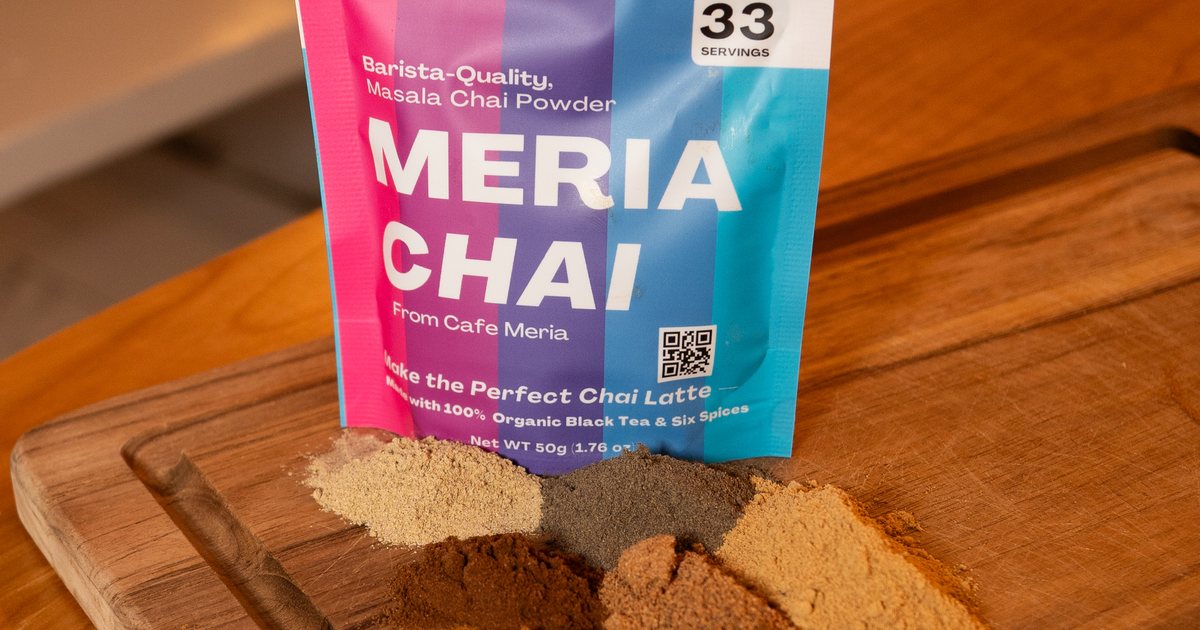
If you already know what you're looking for and just want the cup we serve from our café register: Meria Chai is six organic-sourced spices, organic black tea, no sugar, 33 servings per pouch, $19. Free shipping on every order. The full framework — what to look for in any brand — runs below.
Barista-quality masala chai
No sugar. No stevia. No exceptions.
Meria Chai is black tea and six organic spices — the same blend we pour at the café, with no sweetener of any kind in it. You decide the sweetness, or you don’t.
Get my chai · From $19Free shipping • Cancel anytime
Instant Masala Chai vs Masala Chai Powder: What's Actually Different
The names sound interchangeable, and most product listings treat them that way. They aren't. "Masala chai" describes the recipe — black tea brewed with whole spices, traditional across South Asia. The format you buy it in is a separate question: a stovetop simmer, a refrigerated liquid concentrate, a stir-in powder you measure by the spoon, or an instant version that goes straight into the cup in seconds.
The format you choose changes how fast you brew and how much equipment you need. The quality of what's in the format is a separate question entirely — covered in the next section.
| Format | How it brews | Spice exposure | Best for |
|---|---|---|---|
| Stovetop masala chai | 10–15 min simmer with whole spices and milk | Highest — every spice steeped fresh | Weekend ritual, traditional preparation |
| Liquid concentrate | Pour-and-mix from a refrigerated bottle | Moderate — pre-extracted, then diluted | Iced lattes at home, fast café-style drinks |
| Masala chai powder (stir-in) | Frothed or blended into hot milk for 30–60 sec | Moderate to high — depends on ingredient ratio | Daily drinkers who don't want to measure spices |
| Instant masala chai (done right) | Emulsifies into hot milk, no steeping | High — when the powder is real spice, not flavoring | Café register, office, travel, daily cup |
The difference between concentrate vs powder is a format choice. The difference between real instant masala chai and the sugar-led version is a quality choice. They're different conversations, and most aisle-level buying confusion comes from collapsing them into one. We've also written about five categories of instant chai compared if you want the full taxonomy across formats.
What "Instant" Should Mean (and What It's Become)
There's nothing wrong with instant as a format. Café-grade soluble coffee exists. Instant matcha exists. The problem isn't the format — it's what brands have done with the word.
"Instant should describe how fast you brew it — not what got cut from the recipe."
— Jesse, Founder
Done right, instant masala chai powder is a real product. Black tea, ground with the traditional warming spices, sometimes a touch of milk solids if it's a latte mix, and that's it. It goes straight into the milk. It tastes like chai, because it's made of chai. It's shelf-stable for a year, it doesn't need refrigeration, and you can carry it through airport security in a single pouch. We use it behind our café bar because it lets us serve a consistent cup faster than a stovetop simmer, with the same ingredients we'd put in the pot.
Done wrong — and most of the category is done wrong — instant becomes a cost-engineering exercise. The first ingredient is sugar. The second is maltodextrin, a corn-derived filler that bulks up the powder and helps it dissolve. The third is "natural flavors," a regulatory term that lets a brand replace actual cardamom with a flavor compound that approximates it. Real spices are expensive; cardamom alone runs above $30 per pound. Maltodextrin is pennies a pound. The economics of cheap instant chai aren't a mystery — they're just rarely written down on the front of the box.
The fix isn't to abandon instant. The fix is to demand that "instant" go back to meaning what it should: a fast format for a real recipe. That's a label-reading exercise, not a category exit. The next section gives you the checklist.
The Six Spices in Real Masala Chai (and What Each Does in the Cup)
"Masala" means spice blend. The traditional Indian masala for chai is a family of recipes — varied by region and household, built around the same handful of warming spices. When we set out to make Meria Chai, we landed on six. Enough to carry the cup, few enough that each one shows up.
Why this matters: when a label lists "spices" as a single line, the brand is hiding the ratio. When a label names every spice individually, the brand is telling you what is in the bag. That is the only difference that matters between "real" and "fake" masala chai powder, and it lives in the ingredient list.
Here is what each of the six does in the cup, and what an honest label looks like for each one.
| Spice | Role in the cup | What "real" looks like on a label |
|---|---|---|
| Cardamom | The floral-citrus top note — bright, aromatic, the spice most people identify as "chai" without knowing it | Listed as green cardamom or cardamom, never "cardamom flavor" |
| Cinnamon | Warmth, body, and a natural perceived sweetness that does the work most brands hand to sugar | Cinnamon (ideally with the variety — Ceylon or cassia — disclosed on a sourcing page) |
| Ginger | The heat. A clean, dry-edged warmth that lifts the back of the throat | Ginger or ginger root, never "ginger flavor" or "natural ginger flavoring" |
| Cloves | Deep aromatic, slightly resinous — the spice that makes chai taste like chai and not like spiced tea | Cloves listed by name. Trace amounts are normal; cloves bully the cup if overdosed |
| Black pepper | A subtle warmth at the finish that opens the other spices and makes the cup feel longer | Black pepper by name. Many cheap mixes omit it entirely; that omission is a tell |
| Nutmeg | Soft, faintly woody warmth that rounds out the harder edges of clove and ginger | Nutmeg — a small line item, but its absence is noticeable |
Six spices, plus organic black tea as the base. That is the entire ingredient list of a real instant masala chai powder. If a label lists more than ten total items, something else is going on — usually sugar, maltodextrin, anti-caking agents, or "natural flavors" doing the work that real spices should be doing.
For the deeper read on supplier testing — what's actually in the spices and why it matters — see heavy metals in chai spices.
The Buyer's Checklist: 4 Red Flags, 4 Green Flags
This is the section to bookmark. Take it to the chai aisle the next time you go. Hold a box, flip it over, and run the label against this list. Fail any red flag, put it back. Pass any green flag, take a closer look.
The whole checklist runs on one idea: you are paying for spices, not corn starch. Every red flag below is a place where a brand has substituted something cheaper for something real, then asked you to pay the same price.
Red Flag #1: Sugar in the First Three Ingredients
Ingredients are listed by weight. If sugar, cane sugar, dextrose, or any "-ose" word appears in the first three slots, sugar is most of what you are drinking. Mass-market chai mixes routinely run 18–22 grams of added sugar per serving. The unsweetened path gives you full control over how sweet your cup gets — see our unsweetened chai powder guide.
Red Flag #2: "Natural Flavors" or "Chai Flavor" Listed Instead of Named Spices
"Natural flavors" is a regulatory catch-all that lets a brand add cheap spice extracts and call it spice. If the label says "chai flavor," "spice flavoring," or simply "natural flavors" instead of naming cardamom, cinnamon, ginger, cloves, black pepper, and nutmeg — the brand is choosing not to tell you what is in the bag. Real spices cost more than flavor extracts. Brands that use real spices say so on the label.
Red Flag #3: Maltodextrin (or Any "-Dextrin") in the First Five Ingredients
Maltodextrin is a corn-derived powder that adds bulk, dissolves easily, and tastes like nothing. It exists on chai labels for one reason: to fill the bag without adding spice. A chai mix with maltodextrin in the first five ingredients is mostly filler at spice prices.
Red Flag #4: A Vague "Spices" Line With No Individual Spice Names
Some labels collapse the entire blend into one word: "spices." Legal under FDA labeling rules, but it tells you the brand is hiding the ratio. The cardamom-to-cinnamon ratio is the difference between a balanced cup and a one-note cup. A label that lists every spice individually is a label written for someone who reads labels.
Green Flag #1: Tea or a Named Spice as the First Ingredient
The single most useful tell. The first ingredient by weight is what the bag is mostly made of. If it is black tea or cinnamon, you are buying chai. If it is sugar or maltodextrin, you are buying something else.
Green Flag #2: Every Spice Listed Individually
Cardamom. Cinnamon. Ginger. Cloves. Black pepper. Nutmeg. When a brand spells out the spices, the brand is telling you the ratio.
Green Flag #3: The Brand Publishes a Sourcing Page or Names a Supplier
Most brands say "premium spices" and stop there. A brand that names its supplier — or links to a public test-results page — is staking its reputation on someone else's lab. Harder to do, more expensive to maintain, more honest. We cover our own approach in the sourcing section below.
Green Flag #4: Ingredient List Under 10 Items, No Fillers
Real masala chai is short. Black tea, a short list of named spices, no fillers, no anti-caking agents, no "natural flavors." If you can read the entire ingredient list in five seconds and recognize every word, you are holding real chai.
Sourcing: The Question No Other Guide Answers
Almost every chai brand on the shelf says the same three words: premium, tested, quality. Almost none of them tell you where the spices came from, who tested them, what the test was for, or how to read the result yourself. The next paragraph is the part most other guides skip, because the answer is either uncomfortable or expensive to produce.
We don't run our own lab. We chose a supplier that runs theirs and publishes the results — every lot, by name, with a URL anyone can check. Five of the six spices in our blend — cinnamon, ginger, cardamom, clove, and nutmeg — come from Red Ape Cinnamon, a U.S. spice company that publishes a per-lot Certificate of Analysis for heavy metals (lead, arsenic, cadmium, mercury) on a public page anyone can read: per-lot test results. Black tea and black pepper are sourced separately, with supplier COAs available on request. We didn't build that test infrastructure; we picked a supplier who already had it and made it part of how we choose what goes in the bag.
Per-lot testing matters more than a single "tested for heavy metals" badge for a specific reason: heavy metals in spices fluctuate by harvest, region, and lot. The same supplier's cinnamon can test clean in March and elevated in July, depending on which farm the harvest came from. A brand that tested once two years ago and printed a "tested" badge on the package is telling you about a different bag of spice than the one in your cupboard. A brand that publishes per-lot results is telling you about the lot you're actually buying. The difference isn't subtle — it's the difference between a static claim and an ongoing record. For a deeper read on why this matters, see our article on heavy metals in chai spices.
A few honest caveats. We're not a USDA Certified Organic finished product — we're made with organic-sourced spices, and the finished blend isn't certified at the bag level. Supplier batch testing reduces risk; it doesn't eliminate it, because trace heavy metals exist naturally in all agricultural products grown in soil. We share our supplier's most recent COA with anyone who emails to ask, and the full sourcing story — including how we vetted each spice and why we chose this supplier — is on our Sourcing page. That's the standard we hold ourselves to. We think every brand in this category should publish the same.
How to Brew Instant Masala Chai (Hot, Iced, Latte)
The whole point of an instant masala chai powder is that it should brew in under a minute. The whole point of a real one is that it should taste like it was simmered for fifteen. Both are achievable from the same pouch, in three formats, with three slightly different ratios.
These are the ratios we use at the café register every morning. They are tuned for our powder; if you use a different brand, adjust the powder volume to taste.
| Step | Hot | Iced | Latte |
|---|---|---|---|
| Powder (weighed) | 1.5 g | 2 g | 1.5 g |
| Liquid | 8 oz milk | 12 oz milk, warmed and emulsified, then poured over ice | 8 oz steamed milk |
| Sweetener (optional) | 1 tsp honey or to taste | 1 tsp maple or to taste | Usually unnecessary — milk's natural sweetness carries it |
| Brew time | Until hot and frothy | Froth, then pour over ice | Until steamed |
The one technique that matters across all three: no water, and no spoon. Sweetener first into the empty pitcher if you want any, then the weighed powder, then all of the milk — and then heat and emulsify the whole thing in one move with a steam wand, a blender, a hand mixer, or a handheld frother. The freeze-dried tea dissolves on its own. The six ground spices never will; they are plant solids that suspend, and only heat plus real mechanical force drives them into suspension and holds them there. Stir it gently and you get grit at the bottom. Hit it hard and you get café-quality every time.
For the hot version, pour it straight from the pitcher. For the iced version, emulsify it warm first and then pour the whole thing over a full glass of ice — that order is what keeps it smooth instead of gritty. For the latte, steam the milk with the powder already in the pitcher, so the spices and the microfoam come up together. A handheld milk frother costs about $12 and turns a kitchen counter into a passable espresso bar.
For the full hot version with photos and step-by-step technique, see our chai latte recipe. For the cold-weather move, see our iced chai latte recipe.
Why Unsweetened (and Why That's Not the Same as Bitter)
The first reaction most people have to unsweetened masala chai is some version of: "Wait — where's the sweetness?" The honest answer is that the sweetness is still there. It is just coming from cinnamon and cardamom instead of from sugar.
We make Meria Chai unsweetened for two reasons. The first is control. When the powder ships unsweetened, you decide what to do next. Add a teaspoon of honey if that is your move. Add maple syrup. Add agave. Add nothing and let the spices carry the cup. A pre-sweetened mix has already made that decision for you, usually with more sugar than you would have chosen and with the sweetener the brand could buy in bulk.
The second reason is flavor purity. Sugar has a way of flattening spice. When the cup runs sweet, the cardamom and the clove and the black pepper get pushed to the back. When the cup runs unsweetened, those spices are doing the work — and you can taste them. Cinnamon adds a perceived sweetness on its own; cardamom carries a floral-citrus brightness that registers as bright, not bitter. Unsweetened is not the same as bitter. Unsweetened is the cup with the spices turned up.
There is an adjustment period. Most people who switch from sweetened mixes to unsweetened chai recalibrate within a week. The first cup tastes thin. The third cup tastes balanced. The seventh cup tastes like the cup you have been looking for, and the old sweetened mix tastes like dessert by comparison. We have watched the same recalibration happen at the café register for two years now — it is reliable enough that we tell new customers up front.
For more on the case for unsweetened, see our unsweetened chai powder guide.
Mass-Market vs Mid-Range vs Real Masala Chai
Here's the comparison most affiliate roundups won't write, because it requires saying out loud what's in the bag. The columns are honest: typical mass-market chai mixes (the ones that come in a paper canister with a brand mascot), mid-range powders (the ones marketed as "premium" or "barista" without the sourcing receipts), and Meria Chai. The rows are the eight buyer questions a reasonable person would actually weigh before paying for a daily cup.
| What you're checking | Mass-market chai mixes | Mid-range powders | Meria Chai |
|---|---|---|---|
| All six spices listed individually | No — usually "spices" or "natural flavors" | Sometimes — partial list | Yes — every spice named on the label |
| Made with organic-sourced ingredients | Rarely | Sometimes — partial | Yes — organic-sourced spices |
| Supplier-Sourced + Tested | No public sourcing or test info | Vague — "tested" badge, no details | Yes — supplier publishes per-lot COAs publicly |
| Added sugar | 18–22 g per serving | 6–12 g per serving | 0 g — unsweetened |
| Maltodextrin / fillers | Common — often top 3 ingredients | Sometimes — mid-list filler | None |
| "Natural flavors" or "chai flavor" | Common — replaces real spices | Sometimes — alongside real spices | None — only named spices |
| Servings per container | 10–15 | 15–25 | 33 |
| Cost per cup | $0.40–$1.00 | $0.50–$1.20 | ~$0.58 |
The framing row is the third one: Supplier-Sourced + Tested. A brand can call itself "premium" without spending a dollar on sourcing. A brand can stamp "tested" on the bag without naming who tested what. But "supplier publishes per-lot COAs publicly" is a verifiable claim — either the URL exists or it doesn't, either the lot is on the page or it isn't. The cost-per-cup row tells the rest of the story: real masala chai costs about $0.58 per cup, mass-market mixes $0.40–$1.00. The difference is what's in the cup, not the receipt.
Why We Made Meria Chai (and Why It's a Café Product Now)
Cafe Meria opened in Charlevoix, Michigan in 2023. We're a small specialty café in a town that doubles in summer, and from day one chai was on the menu. We tried every instant masala chai powder we could buy, retail and wholesale, before we started looking for someone to make us a custom blend. None of them passed the checklist above. The cleanest options on the market still had sugar in the first three ingredients, or used "natural flavors" instead of named spices, or wouldn't tell us where the cinnamon came from.
The recipe is the same one we'd been simmering on the stovetop for guests at home — organic black tea, six spices, no sugar, no fillers — translated into a fine powder that goes straight into hot milk. It's made with organic-sourced spices; the supplier story is in the sourcing section above. The black tea and black pepper are sourced separately. One pouch is 50 grams, 33 servings, and runs $19.
It's the same powder we serve from our café register every morning. That's not a marketing line — it's the operational reason the product exists. We needed a chai we could pour from a 50-gram pouch into the hopper behind the espresso machine, hand to the barista, and have her serve it with confidence to a paying customer who'd taste the difference between sugar with flavoring and real spices in real tea. The recipe had to be repeatable from one bag to the next, the ingredient list had to fit on a small label without abbreviation, and the price per cup had to make sense in a market where coffee is the default. If the product on the Meria Chai page didn't pass that bar — for us, behind our own bar, on a Tuesday morning in February — we wouldn't sell it.
Reading the Label: A Real Example
Here are two labels side by side. One is a typical mass-market instant chai mix — anonymized, since this is not a hit piece on a brand. The other is Meria Chai. Run each one against the four red flags and four green flags from the buyer's checklist above.
Box A — Typical Mass-Market Instant Chai (anonymized). Ingredients:
Sugar, maltodextrin, non-dairy creamer (corn syrup solids, partially hydrogenated coconut oil, sodium caseinate), instant tea powder, natural and artificial flavors, spices, cinnamon, salt, silicon dioxide.
Run the checklist. Sugar is the first ingredient (red flag #1). Maltodextrin is the second (red flag #3). "Natural and artificial flavors" carries the spice load (red flag #2). The word "spices" appears as a single line with no individual names (red flag #4). Of nine ingredients, only one — cinnamon — is a real spice listed by name. There is no black tea; there is "instant tea powder," which usually means heavily processed tea solids. The cup you are about to drink is mostly sugar and corn-derived filler with a wash of flavoring.
Box B — Meria Chai. Ingredients:
Organic black tea, cinnamon (cassia), cardamom, ginger, clove, black pepper, nutmeg.
Run the checklist. Black tea is the first ingredient (green flag #1). Every spice is listed by name (green flag #2). The full list is seven items with no fillers, no maltodextrin, no "natural flavors," no anti-caking agents (green flag #4). Made with organic-sourced spices, sourced from a supplier that publishes per-lot test results (green flag #3).
Both labels are sold as "instant masala chai." One of them is. The other is sugar with chai flavoring. The label is the only place the difference shows up before you taste it.
Where to Buy + Final Call
We started this guide at the chai aisle — picking up a box, flipping it over, reading the back. That's the same posture we want you to leave with. The framework matters more than the brand. Four red flags, four green flags, named spices, no sugar in the top three, a supplier you can look up. If the bag in your hand passes those tests, it's a real product. If it doesn't, put it back and keep looking.
If you'd rather skip the aisle and order direct, Meria Chai is the powder we built for our café register: six organic-sourced spices, organic black tea, no sugar, no fillers, 33 servings per pouch, $19. Free shipping on every order, and subscriptions save 10%. We ship from Charlevoix, Michigan — usually within two business days. If you want to compare options first, our guide to where to buy chai online covers the channels worth checking.
This is the cup we serve from our register. If it works for you, the pouch is one click away.
We started this guide at the chai aisle. We end it the same way we started Meria Chai — by serving the cup we'd want to drink ourselves. Free shipping on every order, 10% off with subscription. The framework above is yours either way.
FAQs
What is instant masala chai powder?
Instant masala chai powder is a pre-blended mix of black tea and traditional Indian spices — cardamom, cinnamon, ginger, cloves, black pepper and nutmeg — designed to go straight into hot milk. The "instant" describes the format, not the recipe. Real instant masala chai is the same ingredients you'd simmer on a stovetop, ground fine and pre-mixed for daily convenience.
Is instant masala chai the same as masala chai mix?
Not necessarily, and the difference matters. "Masala chai mix" usually signals a sweetened, flavored product — sugar, maltodextrin, "natural chai flavor," sometimes powdered creamer — designed to be stirred into hot water for a coffee-shop-style sweet drink. Instant masala chai powder, when done right, is just ground spices and black tea with no sweetener, no flavoring, and no fillers. Read the ingredient list before you buy.
Is instant masala chai powder healthy?
"Healthy" is the wrong frame for a beverage. The right question is what's actually in the cup. Mass-market instant chai mixes are mostly sugar and maltodextrin with trace spice flavoring. Real instant masala chai powder is black tea and named spices with no added sugar. Whether either fits your diet is a question for you and your healthcare provider, not a marketing claim we'd make about our product.
How much sugar is in instant masala chai?
It depends entirely on the brand. Typical mass-market instant chai mixes carry 18–22 grams of added sugar per serving — the equivalent of a sweetened soda. Mid-range powders run 6–12 grams. Meria Chai is unsweetened: 0 grams of added sugar per serving. You add the sweetener you want, in the amount you want, or none at all.
How much caffeine is in instant masala chai?
Meria Chai contains roughly 50 milligrams of caffeine per serving — about half the caffeine in a typical cup of coffee. Other brands vary widely depending on tea ratio and serving size; a chai mix that's mostly sugar and powdered creamer with trace tea may contain 15–30 milligrams. If caffeine intake matters to you, check the brand's nutrition panel rather than assuming.
Is instant masala chai powder the same quality as stovetop chai?
The recipe can be — the format isn't. Real instant masala chai uses the same spices and black tea you'd simmer on the stovetop, ground fine and pre-mixed for convenience. The flavor gap between an instant cup and a 15-minute simmer is small when ingredients match. The gap between real instant masala chai and a sugar-led mix is enormous regardless of brewing time. Quality lives in ingredients, not method.
What is the difference between instant chai and masala chai powder?
"Masala chai powder" usually refers to a stir-in powder that's brewed with hot milk or water — slightly coarser, sometimes requiring a quick whisk or simmer. "Instant masala chai" is finer, and it goes straight into the milk with no steeping and no straining. The recipe inside the bag can be identical; the grind and the solubility profile are what change.
Is unsweetened instant masala chai an acquired taste?
For most palates that have been drinking pre-sweetened chai mixes, the first week of unsweetened chai is an adjustment — usually about seven days. After that, most drinkers find the spices carry the flavor on their own. Cinnamon and cardamom add perceived sweetness without sugar, and most people who switch tell us they don't go back. If you want sweetness, you control it: a teaspoon of honey, maple syrup, or any sweetener you prefer.
How long does instant masala chai powder last?
A sealed pouch of Meria Chai carries a best-by date one year from the pack date; store it in a cool, dry place away from direct sunlight. Once opened, keep it sealed, cool and dry: the flavor fades slowly, it does not spoil. The aromatic compounds in cardamom, cinnamon, and ginger fade over time — the cup gets flatter, not unsafe.
Is instant masala chai powder gluten-free and vegan?
Made with vegan ingredients. Made in a shared facility that processes other allergens. If you have a severe allergy or a celiac diagnosis, contact us before ordering and we'll share the most recent supplier and facility documentation. Other brands vary — some chai mixes contain milk solids or honey, so the only reliable check is the ingredient list and the allergen statement on the package.
Is organic instant masala chai powder worth the price?
Look at the cost-per-cup row in the comparison table above before you decide. A mass-market sugar-led chai mix runs $0.40–$1.00 per cup. A real instant masala chai powder made with organic-sourced ingredients runs around $0.58 per cup. The price-per-container looks higher because the ingredient quality is higher, but the per-cup math closes most of the gap. For us, behind a café register every morning, the answer is yes — because the cup is the product.
What's the best instant masala chai for daily drinking?
The honest answer is: the one that passes the checklist in the section above. Look for all six spices listed individually, no added sugar in the first three ingredients, no maltodextrin or "natural flavors," and a brand that publishes its supplier or per-lot test results in public. That's a framework, not a product recommendation. We make and sell our own — we're biased, and we'd rather you buy a different brand that passes the framework than buy ours without knowing what to look for.
Where can I buy instant masala chai powder online?
Direct from the brand is usually the freshest path — Meria Chai ships from Charlevoix, Michigan, free shipping on every order. For comparing options across channels, our guide to where to buy chai online covers the marketplaces worth checking. Avoid generic third-party sellers if you can't verify the source — chai powders fade aromatically, and stock that's been on a warehouse shelf for a year tastes flat.
Can I use instant masala chai powder in baking or smoothies?
Yes. The powder mixes cleanly into batters, oat porridge, smoothies, yogurt bowls, and energy bites. Use about a half teaspoon per serving — less than the brewed-cup ratio, since the spice flavor concentrates without dilution. The black-tea base will add a faint amber color to lighter foods.
Is instant masala chai powder a good gift?
A 50-gram pouch makes a clean small gift for tea drinkers, baristas, hosts, and anyone who reads ingredient labels. Subscription gift options work for ongoing relationships — coworkers, holiday clients, parents-of-friends. The pouch carries a best-by date one year from the pack date, so timing isn't critical. We pack each pouch by hand, and it arrives looking like the café shelf, not a warehouse box.
These statements have not been evaluated by the Food and Drug Administration. This product is not intended to diagnose, treat, cure, or prevent any disease.
